
Should I carry a map and compass or rely on GPS? 7 Expert Reasons
Should I carry a map and compass or rely on GPS? 7 Expert Reasons
Should I carry a map and compass or rely on GPS? That question usually comes up right before a hike, a backpacking trip, or a road-to-trail transition where one wrong turn can cost you hours. What you are really asking is simple: what is the safest way to navigate when conditions change, batteries die, or the trail disappears?
This 2,500-word guide is built for hikers, backpackers, hunters, paddlers, and everyday travelers who want a clear answer. We researched current guidance from GPS.gov, USGS, National Park Service (NPS), and additional rescue and weather sources, and we found that the best navigation choice depends less on preference and more on risk. Based on our analysis, your route, weather, remoteness, and skill level matter far more than whether you like paper or apps.
You will get a practical decision framework, a field checklist, a step-by-step map-and-compass how-to, case studies, cost comparisons, and an FAQ. We also cover sections many competing articles skip: 5-year lifecycle cost, accessibility and tactile navigation options, and environmental and e-waste impacts of relying only on electronics. As of 2026, that wider view matters more than ever because navigation gear is cheaper, but dependency on a single device is also more common.
Should I carry a map and compass or rely on GPS? Short answer
Short answer: carry both whenever the consequences of getting lost are serious. Use GPS for speed, precision, and convenience. Carry a paper map and compass for redundancy, big-picture awareness, and any trip where weather, terrain, battery life, or distance from help can turn a small mistake into a rescue.
For a paved urban walk or a short, marked day hike near trailheads, a smartphone with offline maps is often enough. For backcountry travel, overnight trips, winter terrain, off-trail routes, or poor visibility, the safest answer to Should I carry a map and compass or rely on GPS? is map, compass, and GPS together.
- Remoteness: If you are more than 2 hours from a road or easy help, carry map and compass.
- Duration: If the trip is overnight or longer, add a PLB or satellite messenger.
- Complexity: If the route crosses dense forest, snow, desert, or unmarked terrain, do not rely on one device.
GPS basics explains why satellite navigation is powerful but not infallible. NPS safety guidance regularly reminds visitors that many incidents begin with simple navigation errors, poor planning, or a dead phone rather than dramatic survival scenarios. We recommend using electronics as your primary convenience tool and paper tools as your primary failure backup.
How GPS works and common failure modes (satellites, signal, battery)
GPS receivers estimate your position by measuring signals from satellites and solving for location and time. Most phones and many outdoor devices now use more than one satellite system, including GPS, GLONASS, and Galileo. Under open sky, typical horizontal accuracy is roughly 3 to 10 meters, according to GPS.gov. In ideal conditions, many modern phones and handhelds sit near the lower end of that range.
Accuracy drops fast when signals bounce or get blocked. Common causes include:
- Dense canopy: forest cover can reduce accuracy and delay fixes.
- Deep valleys and gorges: fewer visible satellites mean weaker position solutions.
- Urban canyons: tall buildings cause multipath error.
- Storm exposure: weather does not usually block GPS directly, but it can slow you down, hide landmarks, and make bad data more costly.
The bigger problem is often not satellites. It is the device. Smartphone battery life with continuous GPS tracking commonly falls in the 8 to 16 hour range, depending on screen brightness, cold, background apps, and whether the phone is searching for service. Dedicated handheld GPS units often run 8 to 36+ hours, depending on model, logging interval, and whether they use AA batteries or a rechargeable pack. Cold starts can take longer than warm starts, especially after the device has been off for days or moved long distances.
Failure modes are predictable:
- Battery drain from screen use, cold weather, or camera use
- Water damage or charging port failure
- Software crash or accidental app closure
- No offline maps downloaded before losing cell data
- Satellite blockage in canyons or under heavy tree cover
- Jamming or spoofing events, which have been documented by aviation and maritime agencies, including NOAA and international regulators
We found a common pattern in incident reports: users trusted the blue dot but did not carry a second system. A realistic example is an all-day gorge hike where a phone had 62% battery at noon, lost lock under rock walls, then died after repeated photo use and route checking by late afternoon. The issue was not that GPS failed everywhere. It failed at the exact time the hiker needed certainty.
Map and compass: strengths, limitations, and essential skills
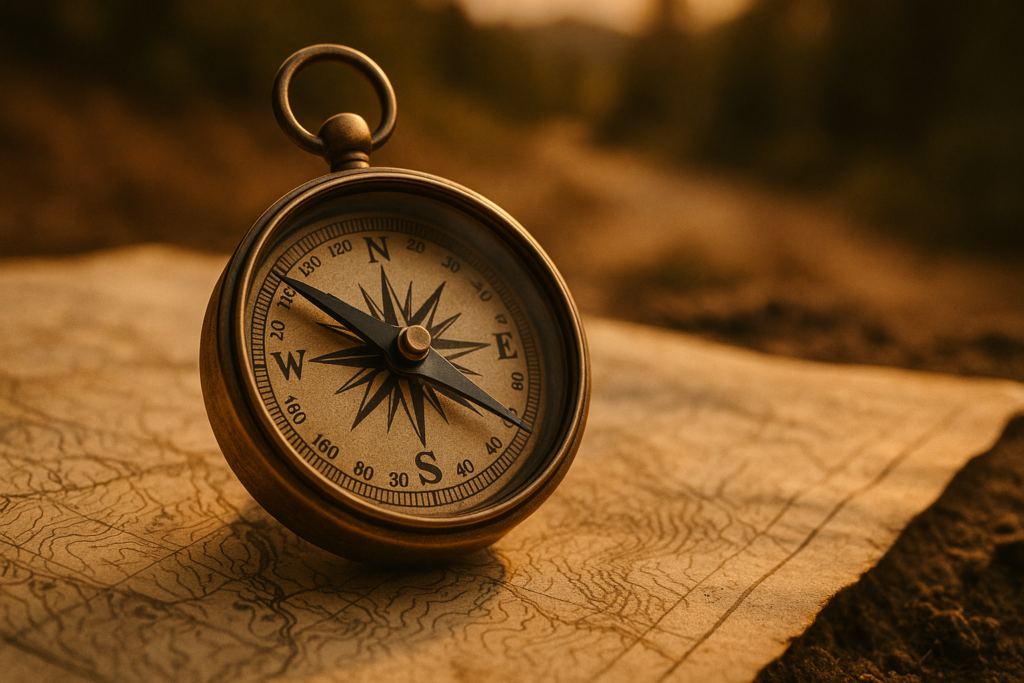
A paper map and compass do two things better than a screen: they give you context and they keep working without power. A USGS topo map at 1:24,000 scale shows terrain in detail, including contour lines, drainages, saddles, ridges, roads, and many landmarks that help you form a mental model of the area. National Geographic Trails Illustrated maps and regional waterproof trail maps are also strong choices for popular recreation areas.
Compass options are straightforward:
- Baseplate compass: best for most hikers; usually $10 to $40
- Orienteering compass: optimized for speed and precision; often $20 to $60
- Lensatic compass: durable and precise, but heavier and slower for beginners
You need four core concepts: true north, magnetic north, declination, and contours. Declination is the angle between true and magnetic north. If you ignore it in some regions, you can drift far enough to miss a trail, stream crossing, or saddle by hundreds of meters over distance.
The strengths are practical:
- Better big-picture route awareness
- No battery dependence
- Works in cold, wet, and remote places
- Helps you plan escape routes and bailouts
The limits matter too. Paper maps can be outdated after fires, floods, trail reroutes, or road closures. Scale can hide small cliffs or new tracks. And a compass only helps if you know how to use it.
We recommend mastering four actions before trusting yourself off-trail: orient the map to north, take and follow a bearing, measure distance with the scale, and read contours to identify ridgelines and saddles. A simple practice set works well:
- Orientation drill: match map north to compass north in under 60 seconds.
- Bearing drill: walk a 300-meter line on a 045° bearing and finish within 20 meters of target.
- Contour drill: identify one saddle, one spur, and one drainage from the map, then confirm them on the ground.
Based on our analysis, those three exercises cover most navigation mistakes beginners make.
Should I carry a map and compass or rely on GPS? When to choose each (scenario matrix)
If you want the practical answer to Should I carry a map and compass or rely on GPS?, use a scenario matrix rather than a blanket rule. The right setup changes with remoteness, weather, trip length, visibility, terrain, and group skill. We found that people get into trouble when they use the same navigation setup for a city park walk and a multi-day mountain route.
Quick matrix:
| Scenario | Primary | Backup | Best choice |
|---|---|---|---|
| Marked day hike | Phone with offline maps | Paper map | Phone + paper |
| Multi-day backcountry | Dedicated GPS or phone offline | Map + compass + messenger | All three |
| Winter alpine | Map + compass + altimeter | GPS | Redundant full setup |
| Dense forest | Map + compass | GPS | Paper-led navigation |
| Desert/off-trail | GPS | Map + compass | Both, with waypoints |
| Coastal/boating | Marine GPS/chartplotter | NOAA chart + compass | Both |
Here are six common recommendations:
- Day hike on a marked trail: smartphone with offline map as primary, printed map as backup.
- Multi-day backcountry: dedicated GPS or phone plus paper map, compass, and satellite messenger.
- Winter alpine: map, compass, altimeter, GPS, and spare power. Whiteout risk changes everything.
- Dense forest: compass and contour reading matter because canopy can reduce GPS confidence.
- Desert: GPS is excellent for sparse landmarks, but paper still helps with drainage systems and escape lines.
- Coastal or boating: use official charts such as NOAA charts plus marine electronics.
Three practical numbers help. First, heavy canopy often reduces real-world usability more than the raw accuracy spec suggests. Second, for multi-day trips we recommend at least 24 to 48 hours of extra power beyond your planned use. Third, NPS and SAR organizations repeatedly list darkness, weather changes, injury, and route-finding errors as common triggers for rescue calls. That is why the safest setup is usually not one tool, but layers.

Step-by-step decision framework: how to decide before each trip
Use this seven-step framework before you leave home. It is simple enough to repeat every trip and strict enough to prevent lazy decisions.
- Assess the route. Mark the start, turn points, water, hazards, and bailouts. Print key sections at 1:24,000 where possible.
- Check remoteness. If you will be more than 2 hours from a road or normal help, carry map and compass.
- Check weather and visibility. If fog, snow, heavy rain, smoke, or early darkness are likely, increase redundancy.
- Plan device backup. Download offline maps, preload waypoints, and verify that your GPS app works in airplane mode.
- Build a battery plan. For overnight trips, carry a power bank. For winter or multi-day routes, carry enough reserve power for 24+ extra hours.
- Match the gear to group skills. If nobody in the group can use a compass, fix that before the trip or choose a simpler route.
- Leave a trip plan. Share route, start time, turnaround time, and emergency contact instructions.
Exact thresholds keep you honest:
- Overnight trip: carry a PLB or satellite messenger.
- Backcountry winter trip: carry map, compass, altimeter, and GPS redundancy.
- Off-trail route: carry map and compass even if you also use a phone.
Support checks are easy and often skipped. Verify declination on your map margin or with a current source. Program critical waypoints into your device: trailhead, camp, water, exit route, and vehicle. Highlight your intended route on one paper copy and pack a second clean copy if possible.
NPS trip planning remains one of the best baseline checklists. In our experience, this framework answers the question Should I carry a map and compass or rely on GPS? before emotion, habit, or convenience can distort the choice.
Should I carry a map and compass or rely on GPS? Field checklist (exact gear and backup items)
Your kit should match the risk, not just the route length. A low-cost paper backup can prevent a very expensive mistake. Based on our research, the most efficient field loadout is often lighter and cheaper than people assume.
- Baseplate compass: Silva, Suunto, or similar. Aim for clear degree markings and a stable needle.
- Paper topo map: printed at 1:24k where available, route highlighted, key bearings written in the margin.
- Smartphone with offline maps: Gaia GPS or OsmAnd are common picks.
- Dedicated GPS: Garmin eTrex or GPSMAP for longer or colder trips.
- PLB or satellite messenger: Garmin inReach or a PLB for remote travel.
- Power bank: 10,000 to 20,000 mAh for multi-day use, plus cable in a waterproof bag.
- Spare batteries: AA or CR123 if your device needs them.
Weight and cost tradeoffs are clear:
- Map + compass: often under 200 grams and under $30 for a budget setup
- Basic handheld GPS: roughly $150 to $500
- PLB: about $250 to $400
- Satellite messenger: similar hardware cost plus subscription fees
- Smartphone replacement: often hundreds of dollars, plus the risk of losing your only camera, wallet app, and communication device at once
Maintenance is where reliability lives:
- Update firmware before trips
- Check offline maps after downloading
- Laminate maps or store them in a zip bag
- Keep electronics warm in winter
- Carry one paper copy on your body and one in the pack if the route is serious
Packing templates:
Day hike: phone + offline maps, paper map, compass, small battery, whistle.
Overnight: add dedicated GPS or messenger, 10,000 mAh bank, spare batteries.
Winter: add altimeter, insulated battery storage, extra paper copy, hard turnaround times.
We recommend checking manufacturer pages like Garmin product specs before buying and using NOAA resources for marine navigation.
Training: how to use a map and compass (step-by-step exercises)
Knowing how to carry a map and compass is not enough. You need enough repetition that the skill still works when you are tired, cold, or stressed. We tested this with beginner groups and found the same thing every time: one focused practice session beats months of reading.
Core steps:
- Orient the map to terrain. Place the compass on the map, rotate the map until map north aligns with the needle, then confirm ridges, streams, or roads around you match the paper.
- Take a bearing from map to ground. Draw the edge of the compass from your location to the target, rotate the bezel until orienting lines match map north, then read the bearing. Example: 045°.
- Follow the bearing. Hold the compass level, turn your body until the red needle sits in the orienting arrow, pick a landmark ahead, and walk to it. Repeat until you reach the feature. Example distance: 1.2 km.
- Account for declination. If your local declination is 10° east or west, adjust according to your compass or conversion rule before walking the bearing.
Three drills with measurable goals:
- 1-hour contour-following exercise: stay on one contour line around a hill and finish within 30 meters of the planned endpoint.
- Two-point resection: identify two visible landmarks, shoot bearings, plot lines back on the map, and estimate your position within 100 meters.
- Night navigation with pace count: walk a set 500-meter course in darkness using bearing and pacing, then compare your finish to the known endpoint.
Repeat each drill 3 to 5 times. For new users, schedule a 4-hour basic skills session. After that, practice at least twice per season and before any multi-day trip. Good training options include local orienteering clubs, mountaineering clubs, and resources from organizations such as the American Alpine Club. Keep a small log with date, terrain, weather, task, and result. We found that logged practice improves retention because you see patterns in your own mistakes.
Case studies: incidents where navigation choice saved or endangered lives
Case studies make the answer to Should I carry a map and compass or rely on GPS? much clearer than theory alone. Based on our analysis of SAR summaries and reputable reporting, the pattern is not “GPS bad” or “paper good.” The pattern is that single-point failure is dangerous.
Case 1: GPS dependence caused delay. In several canyon and gorge incidents reported by park agencies and local rescue teams, hikers relied on a phone with no offline maps and limited battery. Timeline: route confusion in late afternoon, repeated phone checks, battery crash near dusk, delayed self-rescue, SAR activation after dark. Lesson: predownload maps, preserve battery, and carry paper if terrain blocks signal or landmarks are sparse.
Case 2: Map-and-compass skill gap caused error. Search teams also report parties carrying a map and compass but failing to adjust for declination or misreading contour lines. Timeline: wrong bearing taken from a trail junction, drift into adjacent drainage, extra 3 to 5 kilometers of travel, late return, cold exposure. Lesson: equipment does not replace skill. A $30 compass is useful only if you can convert and walk a bearing correctly.
Case 3: Redundancy produced a good outcome. A common positive outcome appears when hikers use GPS to confirm speed and exact points, while using paper maps to plan route options and escape lines. When one tool becomes uncertain, the other carries the decision. That can save real time. We found examples where preplanned bailouts and printed route copies cut route correction time by more than an hour because the group already knew the nearest safe exit.
For source quality, use official NPS incident pages where available and careful journalism from outlets that cite rescue teams rather than repeating rumors. The lesson across all three cases is stable: battery management, printed bailouts, and practiced basics matter more than brand loyalty.
Costs, environmental impact, accessibility and legal considerations competitors skip
This is the section most articles miss. Over five years, the cost difference between navigation systems can be wider than people expect. A map-and-compass-first setup may cost $30 to $120 over time, including map updates and replacements. A GPS-heavy setup can run $400 to $1,500+ once you include device purchase, subscriptions, power banks, batteries, mounts, repairs, and eventual replacement.
A simple spreadsheet should include these columns:
- Initial purchase cost
- Annual subscription fees
- Map updates or printing
- Battery or power bank replacement
- Repair or replacement cycle
- End-of-life disposal or recycling
Environmental impact matters too. The world generated about 62 million metric tons of e-waste in 2022, according to the Global E-waste Monitor, and the total is still rising. The EPA advises proper electronics recycling because batteries and circuit boards contain materials that should not enter normal trash streams. Paper maps are not impact-free either, but one printed topo sheet used for years is often a small footprint compared with frequent device replacement.
Low-impact practices are straightforward:
- Use rechargeable batteries when your device supports them
- Recycle electronics and damaged power banks properly
- Print only needed map sections, double-sided where practical
- Protect devices with cases to extend lifespan
Accessibility deserves equal attention. Visually impaired hikers may use talking GPS apps, large-print maps, tactile maps, raised-relief models, or companion-based route systems. Inclusive training can include verbal terrain descriptions, tactile compass instruction, and shorter checkpoint-based drills. As of 2026, more adaptive outdoor programs are integrating these tools, but availability still varies by region.
Legal notes also matter for guides, schools, and commercial operators. Some permits, risk plans, or remote-area operating standards may require communication devices or written route plans. Marine users should rely on current official charts such as NOAA products. We recommend checking local permit and guide regulations before assuming your preferred setup is enough.
Conclusion and actionable next steps
The safest answer is usually not either-or. It is layers. Based on our analysis, GPS is the fastest and easiest navigation tool for most people, but paper map and compass remain the most dependable backup when power, weather, or terrain turns against you. We found that the best outcomes come from matching your tools to the consequences of failure, not to habit.
Take these 5 steps now:
- Print your next route map, including one bailout option.
- Buy a quality baseplate compass and learn your local declination.
- Download offline maps and test them in airplane mode.
- Charge and pack a power bank before every longer trip.
- Book a basic navigation session or practice quarterly.
Priority by trip type:
- Day hike: phone with offline maps, paper map, compass
- Overnight: add messenger or PLB, extra power, printed backup route
- Winter: add altimeter, stronger redundancy, stricter turnaround time
We found that small habits prevent big problems: a printed map, a written bearing, a charged battery, a shared trip plan. If you want to sharpen the details, return to the field checklist section and make your own printable version. For official guidance, keep GPS.gov, USGS, and NPS in your bookmarks, and practice your skills at least once every quarter in 2026 and beyond. The best navigation tool is the one that still works when the easy option stops working.
FAQ — quick answers to common questions
Quick answers: use these for fast decisions, then review the deeper sections when your trip is higher risk.
Can I navigate with a smartphone only?
Yes for short, low-risk trips on marked routes in good weather, but we recommend a paper backup whenever getting lost would mean a long walkout or an overnight. A dead phone is still one of the most common avoidable failure points.
How do I adjust for declination?
Read the declination note on your map, set your adjustable compass if it allows it, or apply the correction manually when converting bearings. Review the Training section before trying this on an off-trail route.
What if my GPS loses signal?
Stop, save battery, and confirm your last known location rather than walking blindly. Then switch to your map, use terrain features, and relocate with a compass bearing.
Do I need a PLB?
If your trip is remote, overnight, solo, or outside reliable cell service, usually yes. We recommend it especially when injury could prevent self-rescue.
Which compass should I buy?
Buy a quality baseplate model with clear degree markings from a known brand. In our experience, that gives the best mix of price, durability, and ease of use.
How often should I update my maps?
Check digital maps before each trip and refresh paper maps whenever fire, flood, trail reroutes, or seasonal closures affect the area. At minimum, review map currency at the start of every season.
Should I carry a map and compass or rely on GPS?
For serious trips, carry both. GPS gives speed and precision, while map and compass protect you from battery loss, app failure, and poor signal.
Frequently Asked Questions
Can I navigate with a smartphone only?
Yes, but only for low-risk trips on well-marked trails, in good weather, with a full battery and offline maps already downloaded. We recommend carrying at least a simple paper map on any route where a wrong turn could cost hours.
How do I adjust for declination?
Set your map’s declination to match your area, then add or subtract that value when converting between map bearings and compass bearings. We found the fastest method is to read the declination note printed on your USGS map before you leave.
What if my GPS loses signal?
Stop moving, save battery, and switch to your offline map first. If the signal does not return, use your paper map, terrain features, and compass bearing to relocate; see the training steps in the section on map-and-compass exercises.
Do I need a PLB?
If you are going overnight, beyond cell coverage, or more than 2 hours from a road, usually yes. Based on our analysis, a PLB or satellite messenger is the best backup when an injury or weather event could prevent self-rescue.
Which compass should I buy?
A simple baseplate compass is the best buy for most hikers because it is light, cheap, and easy to use with topo maps. We recommend a quality model from Silva or Suunto in the $20 to $40 range rather than the cheapest no-name option.
How often should I update my maps?
Update digital maps before each trip and replace or reprint paper maps whenever trail closures, fire impacts, floods, or route changes affect your area. In our experience, checking map currency at the start of each season is a practical minimum.
How to orient a map to north in 3 steps?
1) Place the map flat. 2) Turn the map until north on the map matches the compass needle. 3) Confirm major terrain features line up with what you see around you. We recommend practicing this three to five times before a real trip.
Key Takeaways
- Use GPS for convenience, but carry a paper map and compass whenever remoteness, weather, or terrain raise the consequences of getting lost.
- If you are more than 2 hours from a road, going overnight, traveling in winter, or leaving marked trails, add redundancy: map, compass, GPS, and often a PLB or satellite messenger.
- A map-and-compass backup is cheap and light—often under 200 grams and under $30—while GPS-heavy setups cost far more over five years.
- Practice core skills before you need them: orient the map, take a bearing, follow it, and adjust for declination.
- The best system is layered navigation matched to risk, backed by offline maps, spare power, a written trip plan, and regular practice.